I have ADHD. I've spent years trying every productivity app on the market and bouncing off most of them within a week. The ones that worked best for me had one thing in common — they didn't ask me to be more organized. They just made the next step feel possible.
Most productivity apps assume the problem is organization. For ADHD brains, it almost never is.
The problem is the choosing. You sit down with three pages of tasks. You read them. You close the app. You open it again. The list itself becomes the obstacle — the tool that was supposed to help you start is the thing keeping you stuck.
That's the friction Bucket was built around.
Not better lists. Not smarter sorting. Just one decision at a time — surface what's next, hide everything else, make momentum the path of least resistance.
I kept circling three questions. None of them were about features.
Most productivity apps are built on accountability. The good ones for ADHD brains have to be built on forgiveness.
I went deep on the research before I touched a screen.
Task chunking. Externalizing memory. Ambient cues. Why initiation is harder than execution. Why "do it later" is the most underrated feature a productivity app can ship.
Then I audited the apps people were already using and watched where they leaked friction. What people did the moment they got overwhelmed — which was, almost universally, close the app.
Three things kept showing up:
Single-focus framing makes starting easier. Quick wins sustain momentum — but only if "do later" is just as easy as "done." And ambient cues — widgets, gentle reminders — beat notifications every time.
The principle was simple. Make one step at a time the default — not a feature buried in a menu, but the actual interaction model.
Three pillars sat underneath every decision:
Focus over everything. Always one task in Focus Mode. The rest goes quiet.
Momentum by design. Quick completion. Soft prompts. Never demands.
Graceful deferral. "Do Later" is a first-class action — same weight as "Done." Never a failure.
The voice had to match. Calm. Encouraging. Never judgmental. The kind of friend who'd say "let's just do this one thing."
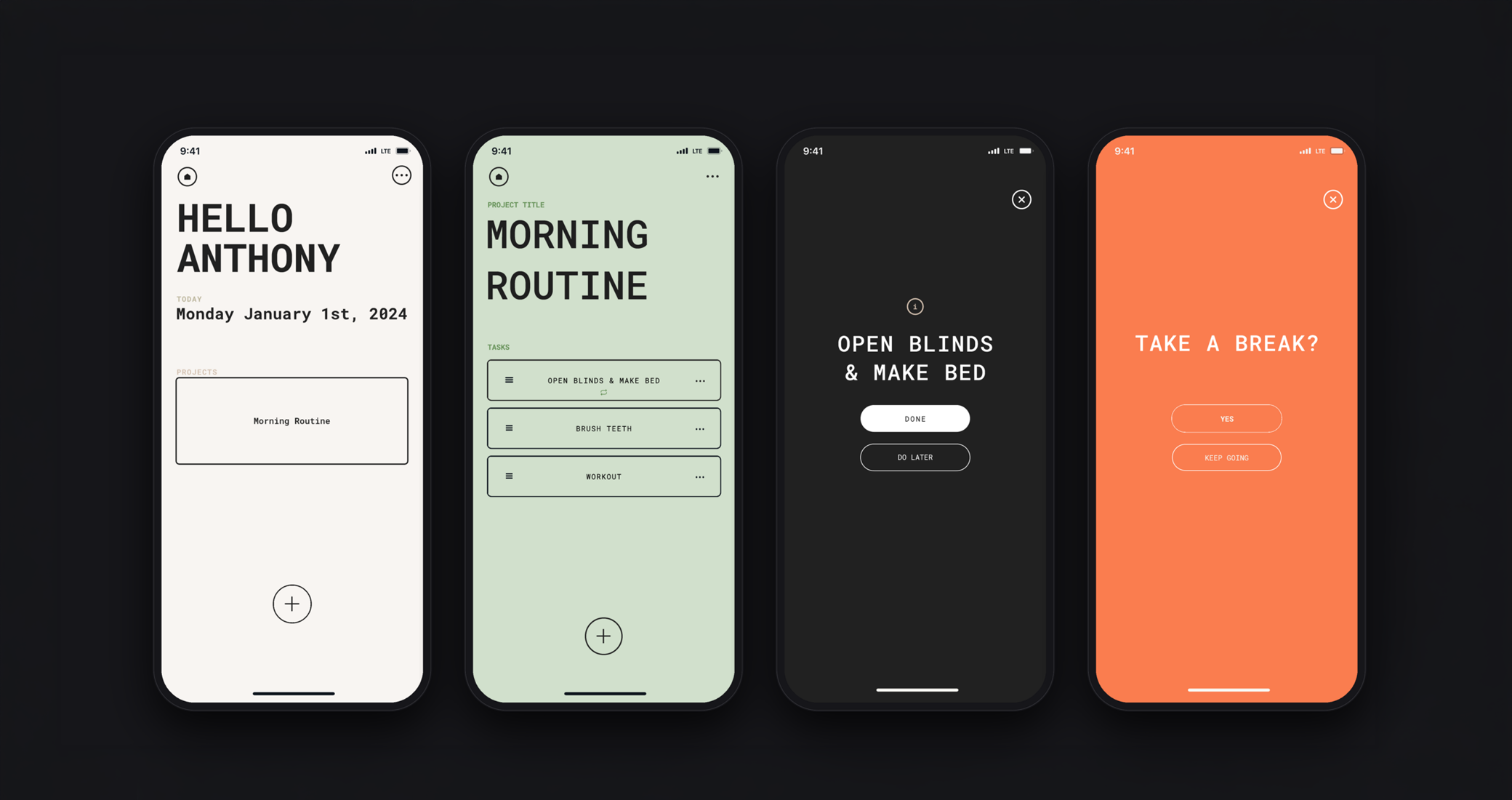
The home is just a warm hello, the date, and your projects. The add button sits dead center at the bottom — closest to the thumb, lowest cost. Nothing else competes for attention.
One field. No setup wizard. No decisions you don't need to make yet.
Built around the order itself. Drag to reorder equals execution order. Top of the list is what's next. The hierarchy is the plan.
Recurring tasks are a quiet superpower for ADHD brains. They remove the daily decision of whether to do the thing. Toggle recurrence on, pick the days. Compact weekday chips so the whole week fits on one row.
One task. Two buttons. Finish or do later. The rest of the world goes quiet.
Do Later doesn't punish. It pushes the task down one slot and reveals the next. You're still moving. That matters more than you'd think.
When you finish, a small affirmation appears. Not a confetti cannon. A quiet good. Dopamine, not noise.
After every finish, the "What's next?" sheet asks — take a break, done for today, or next task. Three calm choices. No default. No autopilot.
When you're in focus, the widget shows the current task with a tap-to-finish affordance — pulling you into Next? / Undo without ever opening the app. When you're not in focus, it nudges gently. Pick a project. Start a session.
The breakthrough wasn't a screen. It was a reframe.
For most productivity apps, "do later" is failure. For us, "do later" is survival — and often the only way the work gets done at all.
The piece I'm proudest of is the part most people will never notice. That Do Later doesn't apologize. Doesn't punish. Just keeps you moving.
That's the kind of work I want to make. The kind that doesn't ask people to be more disciplined to fit the tool. The kind that meets people where they are. Helps them feel seen. Then helps them get going.
The breakthrough wasn't a screen. It was a reframe.
For most productivity apps, "do later" is failure. For us, "do later" is survival — and often the only way the work gets done at all.
The piece I'm proudest of is the part most people will never notice. That Do Later doesn't apologize. Doesn't punish. Just keeps you moving.
That's the kind of work I want to make. The kind that doesn't ask people to be more disciplined to fit the tool. The kind that meets people where they are. Helps them feel seen. Then helps them get going.

